
Focusing on Retinal: A New Selection of Efficient and Mild Anti Aging Skincare Ingredients Driven by Biological Synthesis Technology
In the current trend of deepening the "early C, late A" skincare concept, vitamin A ingredients have always occupied a core position in the skincare market due to their excellent anti-aging effects. Among them, all-trans retinal (atRAL, abbreviated as retinal), as a key derivative of the vitamin A family, has strong anti-aging activity and good tolerability, gradually becoming a high-quality alternative to traditional retinol. OsBio (Suzhou) Biotechnology Co., Ltd. relies on mature biosynthetic technology to break through the problem of retinal synthesis and launch high-purity biosynthetic retinal raw materials, providing efficient and safe anti-aging solutions for the skincare industry.
The skincare advantages of retinal: ATRA's "high-quality precursor" and a mild anti-aging "transit station"
In vitamin A derivatives, anti-aging activity follows a gradient order of "A ester < A alcohol < A aldehyde < A acid". Although all-trans retinoic acid (ATRA) is the most active anti-aging ingredient, its strong irritant properties limit its daily skincare applications. Retinol, although mild, requires a two-step enzymatic reaction to convert into ATRA, resulting in significant activity loss and slow onset of action.
Retinal precisely balances "efficacy" and "mildness":
-
Efficient conversion, faster onset: Only a single enzymatic reaction is required to convert into active ATRA, with a conversion efficiency equivalent to 11 times that of retinol. This allows it to quickly activate anti-aging pathways and shorten the skin rejuvenation cycle.
-
Multi-effect synergy, covering multi-dimensional skincare needs: With direct antibacterial activity, it can simultaneously improve acne problems and achieve the dual value of "anti-aging + anti-acne".
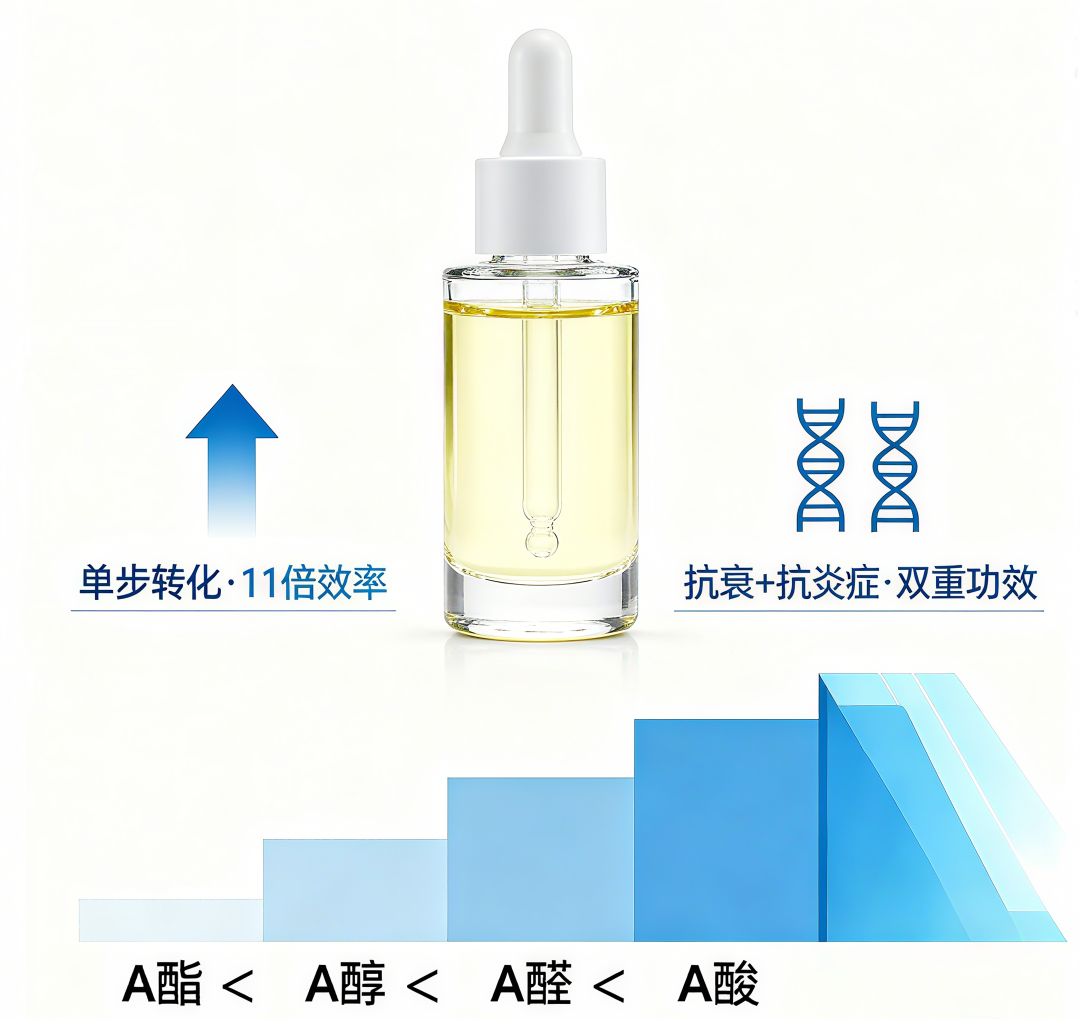
Clinical data supports the anti-aging efficacy and advantages of retinal
The skincare value of retinal has been validated through multiple international clinical studies, demonstrating significantly superior effects in anti-aging, repairing, and other dimensions compared to traditional retinol.
Anti-aging effect: significantly improves wrinkles, elasticity, and skin tone
In a double-blind, randomized controlled trial【1】,the subjects used 0.05% -0.1% concentration of biosynthetic retinal on half of their face (0.05% for the first 4 weeks and 0.1% for the last 4 weeks), and the same concentration of retinol on half of their face. After 8 weeks, the test data showed:
-
wrinkle improvement: The depth of crow's feet in the retinal group decreased by 23.7%, which is more than twice that of the retinol group (10.27%);
-
skin elasticity: The skin elasticity of the retinal group increased by 20.34%, significantly higher than the 11.86% of the retinol group (p<0.001);
-
Skin hydration: After testing, the skin moisture content in the retinal group increased by 53.97%, far exceeding the 35.78% in the retinol group. The retinol group needs to be continuously used for 12 weeks to achieve the anti-aging effect of the retinal group for 8 weeks.
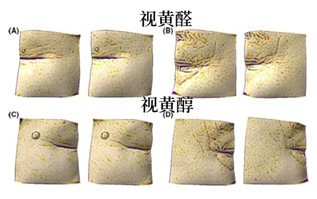
(A) (B): Photos of the patient before and after the application of topical retinal 0.05/0.1% for 8 weeks.
(C) (D): Photos of the same patient on the contralateral side before and after 12 weeks of retinol application at 0.05/0.1%.
Photoaging repair: improving UV damage marks
Another international multicenter study involving 1,462 participants showed that daily use of skincare products containing 0.05% retinaldehyde for 90 days significantly improved the symptoms of photoaging caused by ultraviolet radiation, including wrinkles, pigmented spots, and telangiectasia【2】.
-
Caused by ultraviolet radiation, wrinkles, pigmentation spots, and telangiectasia, the symptoms of photoaging have significantly improved.
Biological synthesis technology: OsBio's core competitiveness in retinaldehyde
The current market for retinaldehyde relies heavily on chemical synthesis, and there are two core issues. First, the synthesis process is prone to producing multiple types of invalid isomers, resulting in insufficient activity of the raw materials. Second, chemical synthesis is accompanied by residual by-products that may increase the risk of skin irritation.
As a spin-off company of the Oxford Suzhou Centre for Advanced Research (OSCAR), OsBio relies on advanced biomanufacturing technology to achieve the biosynthesis of retinal and has three major technological advantages:
- High purity, guaranteed activity: As confirmed by high-performance liquid chromatography (HPLC), the product is high-purity all-trans retinal with no ineffective isomers, ensuring precise and efficient anti-aging activity.
- Safe and skin-friendly, reduced irritation: The synthesis process involves no chemical reagent residues or by-product pollution, and the raw materials have lower skin irritation, making them suitable for various skincare formulation requirements.
- Green and sustainable: Adhering to the "renewable raw materials and clean processes" characteristics of biomanufacturing, this approach reduces environmental pollution and aligns with the green development trend of the cosmetics industry.

Not just the skin! The "Comprehensive Anti-Aging New Value" of Retinal
Unlike traditional anti-aging ingredients that only focus on the skin, retinal, with its unique biological function, demonstrates potential value in the fields of "visual health" and "neuroprotection," providing new possibilities for "full-lifecycle anti-aging"

The 'age guardian' of the visual system
Retinal is the core pigment of the visual cycle — it is the chromophore of rhodopsin, which absorbs photons and drives visual signal transduction through "all-trans to 11-cis isomerization". Retinal can maintain the visual cycle and reduce visual degradation caused by decreased photoreceptor function. As age increases, a decrease in retinal synthesis can lead to reduced visual cycle efficiency, thereby increasing the risk of age-related eye diseases such as age-related macular degeneration and night blindness.
The 'potential protective shield' of neural aging
According to the latest research, retinal can indirectly participate in neuroprotection: after conversion to ATRA, it promotes DNA repair through the retinoic acid pathway, reduces oxidative stress damage, and indirectly slows down the aging rate of nerve cells-ATRA has shown potential to improve learning and memory and reduce β-amyloid deposition in neurodegenerative disease models such as Alzheimer's disease. Although this direction is still in the research stage, it has provided scientific basis for "anti-aging is not just superficial".
OsBio has currently launched high-purity biosynthetic retinal raw materials and looks forward to working with global skincare brands and partners in the health field. As an innovative enterprise in the field of biomanufacturing, OsBio will continue to deepen the research and production of high-performance skincare ingredients such as retinal, drive the development of the skincare industry with technological innovation, explore more application possibilities of retinal, and jointly inject new vitality of green biomanufacturing into human health and the beauty industry!
References:
【1】Kim, J., Kim, J., et al. The efficacy and safety of multilamellar vesicle containing retinaldehyde: A double-blinded, randomized, split-face controlled study, Journal of Cosmetic Dermatology,2021, 20(9): 2874-2879.
【2】Cordero A., Leon-Dorantes G., et al. Retinaldehyde⁄hyaluronic acid fragments: a synergistic association for the management of skin aging, Journal of Cosmetic Dermatology, 2011, 10(2): 110-117.


